
Checking Criminal History in Troy
Start by defining the record you need. Troy Police is the source for a report written by a Troy officer. The 52-4 District Court is the local source for public misdemeanor cases and felony proceedings before bindover. The Oakland County jail channel answers current or recent custody questions. Sixth Circuit Court Explorer takes over the public felony trail after bindover, and Michigan State Police ICHAT provides a broader public name-based history for Michigan.
- Identify Troy Police as the likely arresting or investigating agency and note the date, place, names, and report number if known.
- Request the releasable Troy incident or arrest report through the official police records or FOIA route.
- Search 52-4 District Court by party name or case number for a misdemeanor or the early stage of a felony.
- Use Oakland County custody information for a booking, then Court Explorer if a felony was sent to Sixth Circuit.
- Use ICHAT when reviewing a statewide public Michigan history, and verify any match against the court file.
No one step replaces the others. A Troy police narrative can exist without a jail stay, and a booking can appear before prosecutors settle on the filed charge.
Troy Records Along Big Beaver
Troy is a large suburban commercial center shaped by the Big Beaver Road and I-75 corridor. Its records chain remains city-specific even when county agencies become involved later. The official City of Troy source shows the local government setting in which police and court access begin.

That local starting point matters. A Troy officer creates the incident or arrest report, and the city court records the first case events. The fact that an arrested person may later appear in the Oakland County jail does not transfer custody of the police narrative to the sheriff. Searchers save time by asking each office only for the record it created.
Record sequence: Troy Police report › local court event › Oakland booking when applicable › circuit case after felony bindover.
Troy Police Department Records
The Troy Police Department is the first custodian for reports made by its officers. A focused request should give the incident or report number if known, the event date and location, involved names, and a clear description of the desired material. It should also say whether inspection or a copy is preferred. Current forms, direct records contacts, hours, and fees should be confirmed on the department’s official page because the indexed research did not expose a stable fee schedule.
The department’s public contact is centered at 500 W. Big Beaver Road, Troy, MI 48084. The city main number is 248-524-3300. A request may be narrowed or redacted when an investigation, personal privacy, confidential source, protected identifier, or safety concern is involved. Asking for reasonably segregable nonexempt portions can help when part of a report cannot be released.
The official Troy Police source also provides a useful view of the city’s local criminal-record custodian.
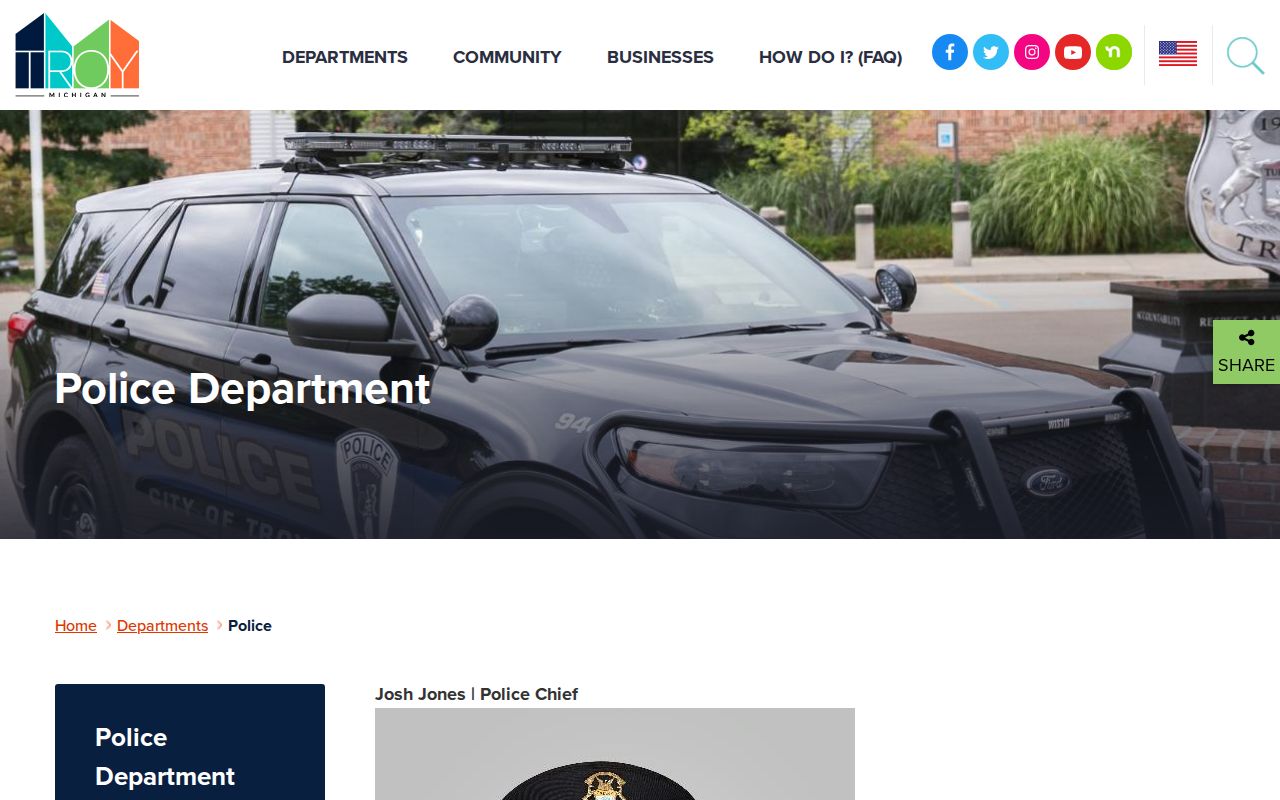
The image connects the request route to the agency that authored the underlying report, rather than to a county database that may show only booking or court data.
Troy Report and Booking Records
A Troy police report and an Oakland booking entry document different acts. The report records the officer’s investigation and legal basis. A booking record is made only if custody is accepted, and it can contain an intake time, booking number, custody charge, bond or hold, fingerprints, and a photograph. Neither record by itself proves a conviction.
| Record | Primary Troy Route | What It Answers |
|---|---|---|
| Incident or arrest report | Troy Police records or FOIA | What officers documented and why action was taken |
| Booking entry | Oakland County jail locator or inmate information | Whether county custody was recorded and which court controls the charge |
| Case file | 52-4 District Court, then Sixth Circuit if bound over | What prosecutors filed and how the court resolved it |
Use identity details with care because common names can produce a false match. Compare the agency, event date, court, and case number before treating two entries as part of the same Troy matter.
Troy Arrests and Bookings
Troy may process a person briefly, but the public county custody path is the Oakland inmate locator and the jail’s inmate-information line at 248-858-1800. The locator can be as much as 72 hours out of date. An absent result may mean release, transfer, a data delay, custody in another county, or that no Oakland booking occurred. It should not be treated as proof that no Troy arrest happened.
Call the court of jurisdiction for controlling charge and bond details. Jail staff can help identify the court, but the booking label may reflect an early allegation that prosecutors later change or decline. For a deeper explanation of intake and custody fields, the county Arrest Lookup follows the Oakland booking process without replacing Troy’s report channel.
Note: A booking entry proves that custody was recorded, not that a judge or jury found the person guilty.
Searching Troy 52-4 Records
The 52-4 District Court is the city-level court route for Troy matters. Michigan district courts handle misdemeanors punishable by no more than one year and the initial stages of felony cases, including arraignment, bond, probable-cause conference, and preliminary examination. Public searches generally begin with a party name or case number through the court’s official access route or MiCOURT, followed by contact with the clerk for a document that is unavailable online.
A search can disclose the case number, filing date, status, judge, charge description, hearings, public register events, disposition, sentence, and financial assessments when public. Online material is informational. The clerk’s maintained file controls, and protected identifiers, juvenile cases, sealed matters, and other nonpublic material will not appear.
- Arraignment
- The first court appearance at which the charge and rights are addressed.
- Preliminary examination
- A district-court hearing on whether probable cause supports sending a felony onward.
- Bindover
- The transfer of a felony from district court to Oakland County Sixth Circuit Court.
Municipal Court Records in Troy
Troy does not use a separate municipal court for criminal adjudication. Its local criminal docket runs through 52-4 District Court, so readers should not search for a nonexistent city municipal-court database. The distinction is more than a name. The district court applies state jurisdiction to misdemeanors, traffic matters, and felony preliminary proceedings while serving as the local counter for Troy case records.
| Court Name | 52-4 District Court serving Troy |
|---|---|
| Case Types Heard | Misdemeanors, traffic matters, and felony arraignment, bond, conference, and examination stages |
| Case Lookup Channel | Official 52-4 court route or participating MiCOURT search; clerk contact for unavailable records |
| What the Docket Shows | Public case number, parties, charge, events, hearings, status, disposition, and sentence where available |
| Copies & Fees | Request from the court clerk and confirm the current copy or certification charge before ordering |
MiCOURT may show convictions only when sentencing falls within a seven-year display window at some courts. An older Troy case can still exist even when a web search returns nothing.
Troy Records Beyond MiCOURT Filters
MiCOURT warns that some participating courts display criminal convictions only when sentencing occurred within seven years. That is a screen limit, not a rule that destroys the maintained Troy court record. Protected case types also remain outside public display, and a court may hold an older paper or offline file that cannot be retrieved through a simple name query.
When a known Troy matter does not appear, confirm that 52-4 is the correct court, try the complete case number, and contact the clerk with the party name and approximate year. If the matter was a felony, ask whether it was bound over. The next search may belong in Oakland Court Explorer rather than MiCOURT. Do not treat “no results” as proof of no arrest, charge, or conviction.
Michigan also cautions that an attempt charge under MCL 750.92 may temporarily display as a felony even when subsection (3) makes it a misdemeanor. Verify the classification with the court and statute.
When Troy Felony Records Move
A felony starts in 52-4 but does not remain there after bindover. Under the amended Michigan court rules, the district felony file becomes nonpublic once the matter is bound over. The continuing public case then belongs in Oakland County Sixth Circuit Court Explorer. This change often looks like a vanished Troy case when the file has actually moved to Pontiac.
Search the circuit system using the same legal name, then compare charge dates and counsel. For a post-July 2, 2024 bound-over district transcript sought by an interested nonparty, Oakland directs the request through courtexplorer@oakgov.com so the clerk can route it to the proper court reporter or official. Parties and counsel retain their authorized routes.
Practical pointer: A missing 52-4 felony result after bindover is not a set-aside or dismissal. Check Court Explorer and ask the Oakland clerk which file now controls.
Where Troy Records Go
Troy Police creates the local report. County booking staff create a custody record when the jail accepts the person. The prosecutor decides which charge to authorize, and the district clerk records the local proceedings. A felony disposition moves through Sixth Circuit, while fingerprints and reportable arrest-cycle data reach the Michigan State Police Criminal Justice Information Center.
Record flow: Troy Police Department › Oakland County Courts › Michigan State Police CJIC
That flow explains why the newest details are often at city or district-court level, while an older completed event may appear in Court Explorer and ICHAT. ICHAT costs $10 per public name search, covers public Michigan history, and omits nonpublic and set-aside material. It is not the underlying Troy report, a nationwide check, or a substitute for the judgment. Results remain available online for seven days after payment.
Troy Probation Record Boundaries
The MDOC Troy Probation office at 1151 Crooks Road, Troy, MI 48084, phone 248-655-1100, supervises adult felony probation through Michigan’s Field Operations Administration. It is not the same office as misdemeanor probation associated with 52-4 District Court. That division can trip up a reader who sees “Troy probation” and assumes one custodian holds every file.
Use the sentencing court for the public judgment, probation order, or violation events in the case docket. Use MDOC channels for felony supervision information within their published scope. OTIS can include MDOC prisoners, parolees, and felony probationers under supervision or discharged within three years, but it excludes county-jail-only people and unsentenced individuals. A missing OTIS result is not a complete Troy criminal-record clearance.
Public Access Rules in Troy
Michigan FOIA applies to releasable records held by Troy Police and other city offices. A written request must describe an existing record well enough for staff to find it. The city generally has five business days to respond, with one allowed ten-business-day extension. Permitted charges can cover actual labor, copying, and mailing, and the public body must itemize them. Police exemptions may protect active enforcement work, fair-trial rights, personal privacy, sources, techniques, or safety information.
Court records use Michigan Court Rule 8.119 rather than ordinary FOIA. MCR 1.109 protects personal identifying data, and the bindover rules restrict the former district felony file. Ask the proper clerk for the public portion instead of trying to obtain a court file through a police request.
Key Statutes:
Michigan FOIA, MCL 15.231 states the policy favoring public access to government records.
MCL 15.235 sets the response period and permitted extension.
MCL 15.243 identifies exemptions that can require withholding or redaction.
Michigan Court Rule 8.119 governs court-record custody and public access.
A denial may be appealed under MCL 15.240. For a partial denial, request the nonexempt portions and a written explanation of each redaction.