
Checking Criminal History in Oakland County
No single search supplies a complete Oakland County criminal record. Start with the event or document you need. A Sixth Circuit felony file belongs with Legal Records. A misdemeanor or the first stage of a felony belongs with the district court that handled it. The Oakland County Sheriff’s Office holds its own incident reports and county jail material. Michigan State Police compiles the public statewide history sold through ICHAT. Each source answers a different question, so a missing result in one place should lead to the next proper custodian rather than an assumption that no record exists.
Use a full legal name, likely spelling variants, an approximate date, and a date of birth when the official system permits it. Common names require added care. Compare the court, filing date, charge, and case number before relying on a match. A practical Oakland County criminal record check follows this order:
- Search the relevant district court and Sixth Circuit channel for filed cases.
- Check county custody when the event may involve a recent booking.
- Request the incident report from the police agency that created it.
- Use ICHAT for a public statewide Michigan name-based history.
- Order a clerk-certified record or use the MSP review process when official proof or correction is needed.
That chain separates an accusation, a booking, a filed charge, and a conviction. Those facts can be related without being the same record.
Oakland Court Explorer Case Search
Oakland County’s named circuit portal is Court Explorer. It offers a free name or case-number search for public Sixth Circuit matters. Results can show the case number, caption, filing date, assigned judge, status, parties, attorneys, and a dated register of actions. Available documents may be ordered through a separate control. The free register is an event index, not always the filed PDF and not a certified copy.
The official Court Explorer screen shows how Oakland County felony records are searched.
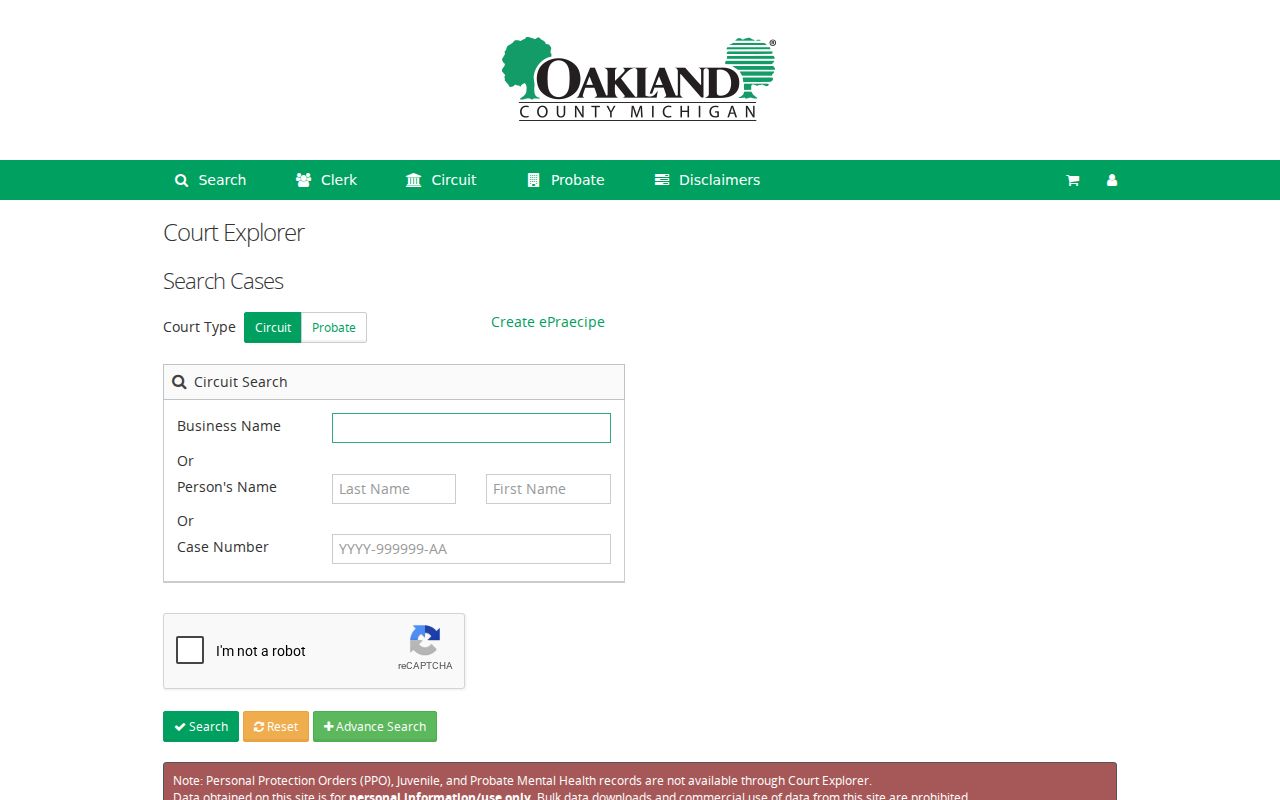
The portal is the best first stop for a continuing Sixth Circuit file, while the clerk remains the source for restricted, older, unavailable, or certified material.
| Search route | Useful input | Result to verify |
|---|---|---|
| Party name | Legal surname and first name | Caption, filing date, and court |
| Case number | Oakland case format | Status and assigned judge |
| Register review | Dated event entries | Charge, disposition, and sentence events |
| Document order | Available linked filing | Whether a copy or certification is needed |
After a felony bindover, the district file can become nonpublic while the circuit case continues. Search both levels and use the clerk’s special transcript route for qualifying post-bindover requests.
Michigan Official Background Checks
The Michigan State Police Criminal Justice Information Center keeps the central criminal-history repository. Its Internet Criminal History Access Tool, known as ICHAT, sells a public Michigan name search for $10. An account and payment are required. The result is available to view and print after payment and remains online for seven days. ICHAT uses identity fields such as name, date of birth, sex, and race. It does not search by Social Security number or driver-license number, and an input error still consumes a paid search.
The MSP criminal-history hub explains ICHAT, record review, correction, Live Scan, and set-aside channels.
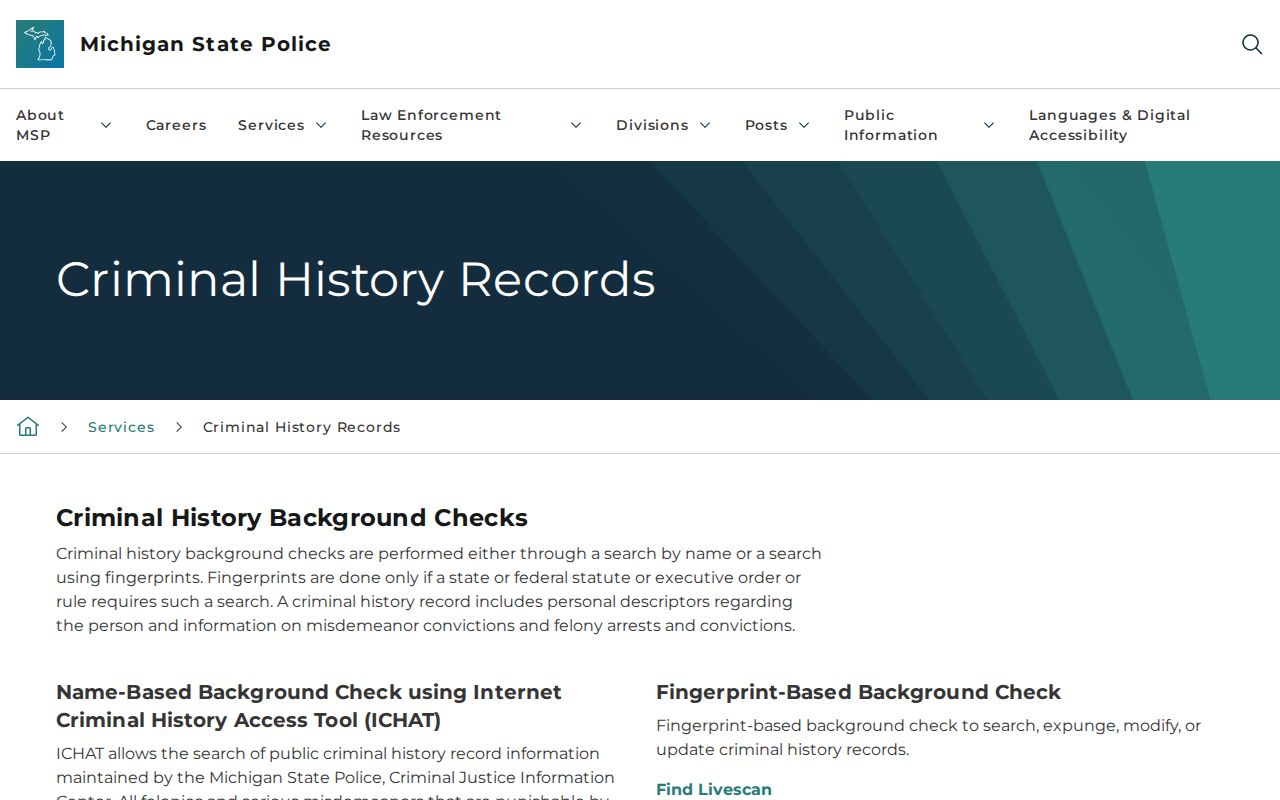
This state source has wider Michigan coverage than Oakland County courts, but it supplies a compiled history rather than pleadings, transcripts, hearing calendars, or every nonconviction case.
Fingerprint checks are limited to purposes authorized by law, rule, or executive order. A person reviewing their own record can follow MSP’s identity-confirmed review process through a Michigan-authorized Live Scan vendor or law-enforcement print site. OCSO provides ink cards for $15 cash per card, and court-ordered prints require an appointment. The FBI Identity History Summary is a separate subject-only federal product.
Oakland Records Unit Requests
The OCSO Records Unit sits at 1201 North Telegraph Road on the east side of the Main Jail in Pontiac. It is open weekdays from 8:30 a.m. to 5 p.m., and visitors should arrive at least 30 minutes before closing. Call 248-858-5011 or email ocsorecords@oakgov.com before making the trip. The counter handles OCSO incident and accident reports, jail files, proof-of-incarceration letters, fingerprint cards, tickets, gun records, and Michigan FOIA requests.
An OCSO incident or accident report generally reaches the counter four to five business days after the event. An in-person copy costs $7 cash and requires photo identification. Ordinary incident and accident requests are not processed by fax. A requester can instead use the official online FOIA route, call or email about availability, visit the east-side counter, or mail a written request. Reports written by Troy, Farmington Hills, Southfield, or another city police department stay with that agency.
OCSO Records Unit
1201 N. Telegraph Rd.
Pontiac, MI 48341
248-858-5011
Weekdays, 8:30 a.m. to 5 p.m.
Legal Records
1200 N. Telegraph Rd., Dept. 413
Pontiac, MI 48341
248-858-0582
Weekdays, 8:30 a.m. to 4:30 p.m.
| OCSO service | Stated terms |
|---|---|
| Incident or accident report | $7 cash, photo ID, call first |
| Local clearance letter | $5 with requester’s state ID or driver license |
| Proof of incarceration | No charge, government photo ID |
| Fingerprint card | $15 cash per card |
The $5 clearance is narrow. It checks whether the requester was arrested by OCSO or held in the Oakland County Jail. It is not a search of every city police department and is not an MSP rap sheet.
Criminal Record Types
Oakland County criminal records are created at different steps. Police write an incident report, an arresting agency records the legal basis for custody, and jail staff create a booking file if the jail accepts the person. The district court then records arraignment, bond, and misdemeanor or preliminary felony events. A felony that is bound over continues in Sixth Circuit. MSP links fingerprinted arrest cycles with reported court outcomes, while MDOC creates a corrections and supervision locator entry.
- Incident report
- The investigating agency’s narrative and evidence record, which can exist without an arrest.
- Booking record
- The jail intake file with custody time, agency, charge, bond, identifiers, and booking status.
- Register of actions
- The court’s dated index of filings, hearings, rulings, and disposition events.
- ICHAT history
- The public Michigan history compiled by MSP, not the underlying police report or full court file.
- OTIS record
- An MDOC custody or supervision locator entry, not a complete criminal history.
Warrants and Michigan PSOR profiles form other specialized records. A warrant is court authority for an arrest or search. A registry profile exists because state law imposes registration duties; it is not a general rap sheet. Dedicated Oakland County arrest lookup guidance and registry guidance explain those limited sources in context.
Oakland Jail Record Delays
The Oakland County jail channel is the public route for current or recent county custody. Users must accept a disclaimer before searching. A profile can show a booking identifier, dates, custody status, demographics, charge descriptions, the court of jurisdiction, bond, and facility status. Medical, security, victim, and other protected information does not belong in the public display.
The sheriff warns that locator information may be as much as 72 hours old. An empty result can mean delayed entry, release, transfer, another county, or no county booking. Call inmate information at 248-858-1800 when timing matters. The court of jurisdiction, not the jail screen, controls charge and bond details. OTIS should be used only after an MDOC transfer or for qualifying felony supervision, because OTIS excludes county-jail-only custody and unsentenced people.
Match before relying: A jail entry proves custody, not guilt, and its booking charge can differ from the prosecutor’s filed charge or final judgment.
Inside an Oakland County Criminal Record
A public criminal record may identify the court, case number, filing date, status, judge, parties, attorneys, charges, statutory codes, offense date, disposition, hearing events, judgment, and sentence. A Michigan repository history can also connect names or aliases, date of birth, demographic identifiers, fingerprints, the arresting agency, arrest date, arrest-cycle numbers, and a reported judicial outcome. Access varies by source and by law.
| Name and identifiers | Names, aliases, date of birth, and permitted identity fields used to match the correct person. |
|---|---|
| Arrest and booking | Agency, date, alleged offenses, booking number, custody status, and bond where public. |
| Charges and statutes | Filed counts, Michigan law citations, offense level, and amendments. |
| Disposition | Dismissal, plea, verdict, or other recorded resolution for each count. |
| Sentence | Judgment, jail or prison term, probation, fines, and public financial entries. |
| Record limits | Protected identifiers, victim facts, juvenile matters, and set-aside files are withheld or suppressed. |
Docket words mark steps, not always outcomes. “Bindover” means the felony moves from district court to Sixth Circuit. “Disposition” means the recorded result of a charge. A warrant entry may reflect a failure to appear or another judicial order. Read the dated sequence and obtain the judgment before treating a single label as final.
Oakland Warrant Record Gaps
OCSO has a named Warrants Unit that enters and confirms warrants from Oakland district courts and Sixth Circuit, makes arrests across Michigan, and helps with extraditions. Yet the county research found no complete public OCSO active-warrant name database. A searcher should use the relevant district court’s public case history, call that clerk, and confirm the warrant type, case number, bond, and appearance instructions with the issuing office.
The Sheriff’s investigative services page identifies the official unit, but it is not a public list of every warrant. Southfield’s 46th District Court separately offers online review for some traffic and non-felony bench warrants. Sealed warrants will not appear in a public search. A stale screenshot also cannot prove that an entry remains active after court action.
Bench warrants often follow a missed hearing or probation matter. Arrest warrants rest on probable cause. Search warrants authorize a search of a place or property and may stay sealed during an investigation. Anyone resolving their own warrant should contact the issuing court or counsel for current instructions.
Public Access Laws in Michigan
Michigan Freedom of Information Act requests apply to agency records such as releasable police and jail files. A written request must describe an existing record well enough for the public body to find it. Court files follow Michigan Court Rule 8.119 instead of ordinary FOIA. This split matters in Oakland County: ask the police custodian for an incident narrative, but ask the court clerk for filed pleadings, orders, judgments, and certified copies.
Key access rules:
MCL 15.231 states Michigan’s policy favoring public information about government affairs.
MCL 15.235 sets the usual five-business-day response framework and permits one written extension.
MCL 15.243 permits specific exemptions for privacy, investigations, sources, techniques, safety, and fair-trial interests.
MCL 780.621 governs application-based set-aside eligibility and procedure.
FOIA allows itemized charges for permitted labor, copying, and mailing. A response deadline is not always the date records will be produced. If part of a record is exempt, ask for reasonably separable public portions rather than assuming the whole document must remain closed.
Oakland Criminal Record Corrections
A missing or wrong disposition can result from a delayed submission, an unmatched fingerprint arrest cycle, or an error in the source court record. Start with the judgment from the sentencing court. If that docket is wrong, ask the clerk about correction. MSP CJIC handles review and challenges to the repository history and can use the RI-027 Judicial Correction Worksheet when a court cannot update the state record electronically.
Keep the paid ICHAT report, transaction details, case number, arrest date, charge, and court judgment. Those facts help isolate the error. MiCOURT also warns of a temporary display issue involving attempt charges under MCL 750.92, where a misdemeanor attempt may appear with a felony label. Verify the offense statute and judgment rather than relying on the portal label alone.
System limits can look like errors. Some MiCOURT participants display criminal convictions only when sentencing falls within a seven-year window. A bound-over district felony file becomes nonpublic under the governing court rules. Set-aside, juvenile, and protected matters may be suppressed by law. The reason for an absence must be checked with the record custodian.
Sealed, Expunged, and Restricted Records
Michigan commonly calls the remedy “setting aside” a conviction, while “expungement” and Clean Slate are also used. Application-based relief and automatic set-aside rules are not identical. Eligibility depends on the offense, exclusions, counting rules, waiting periods, and current law. Serious offenses can be excluded, and registry duties may have separate effects. Age alone never proves that a record qualifies.
For an Oakland Sixth Circuit sentence, the local filing route runs through the Oakland County Clerk. A person may need the judgment, the correct State Court Administrative Office form, certified conviction records, fingerprints, service on required agencies, and a hearing. District court convictions are filed in the sentencing district court. Current instructions and costs should be verified before filing.
The county’s official clerk channel explains the local process. Once relief is processed, ordinary public court and ICHAT results should be checked again. A lawful set-aside can make the official record nonpublic to ordinary searchers, but it does not promise removal of every news story or other outside artifact.
Oakland Supervision Record Limits
Adult felony probation and parole are supervised through MDOC Field Operations Administration. Oakland County falls within Region 10. County-based offices include Oakland Probation and Northwest Operations in Building 26 on the Telegraph campus, Pontiac Parole on North Saginaw Street, and Troy Probation on Crooks Road. District courts handle their own misdemeanor probation functions, so the sentencing court is the right source for a local misdemeanor supervision record.
The MDOC OTIS page supplies the state offender search used for qualifying custody and supervision.
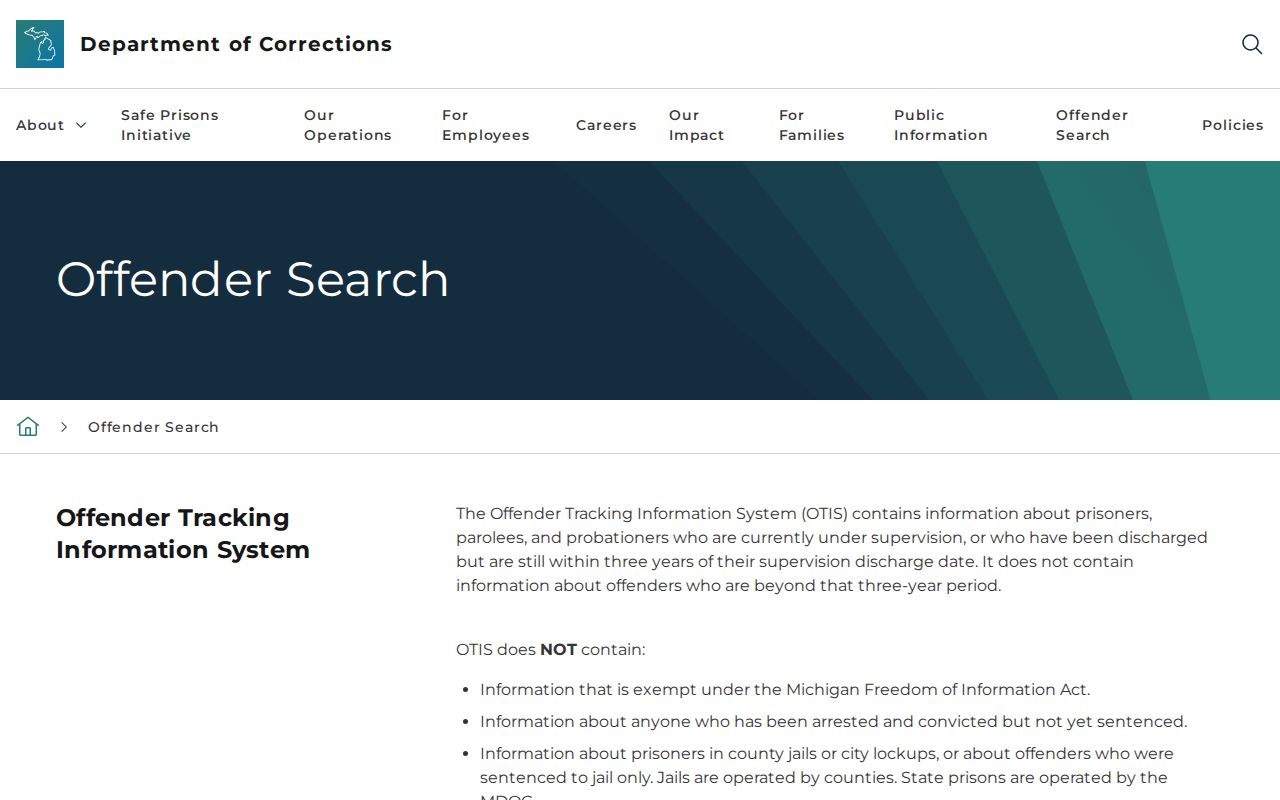
OTIS can show prisoners, parolees, and felony probationers who are currently supervised or discharged within three years. It excludes county jail, jail-only sentences, unsentenced people, and older discharged records.
The Region 10 directory identifies the Oakland County supervision offices.
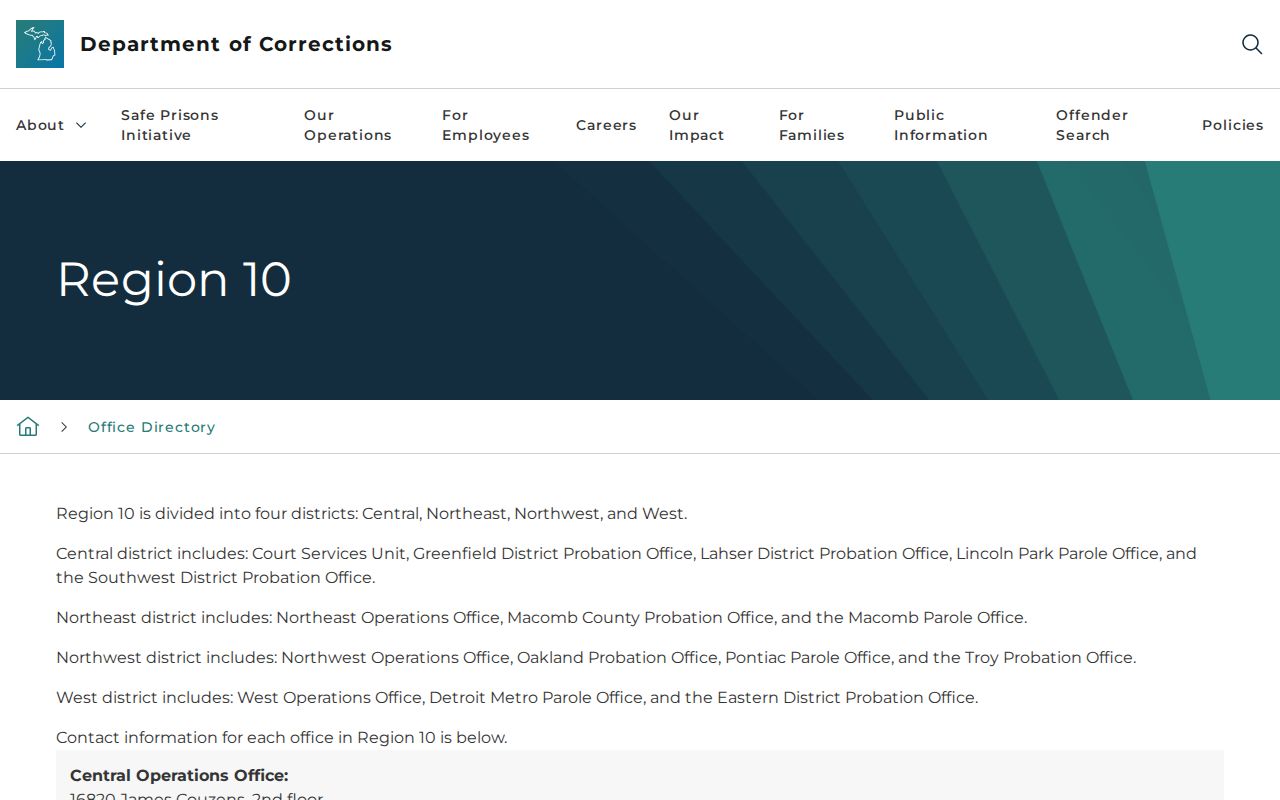
Use the supervision location in an OTIS result, then contact the listed office. Detailed conditions and internal supervision files may remain restricted even when the docket shows the sentence or a violation hearing.
Federal Criminal Records from Oakland
A federal prosecution arising in Oakland County belongs to the U.S. District Court for the Eastern District of Michigan, not Sixth Circuit. PACER is the official federal docket system and requires registration. It can supply docket reports, filed documents, orders, and judgments when public, while sealed filings remain unavailable. Federal fees and waiver thresholds should be checked at the time of use.
The Eastern District of Michigan site identifies the official federal court layer.
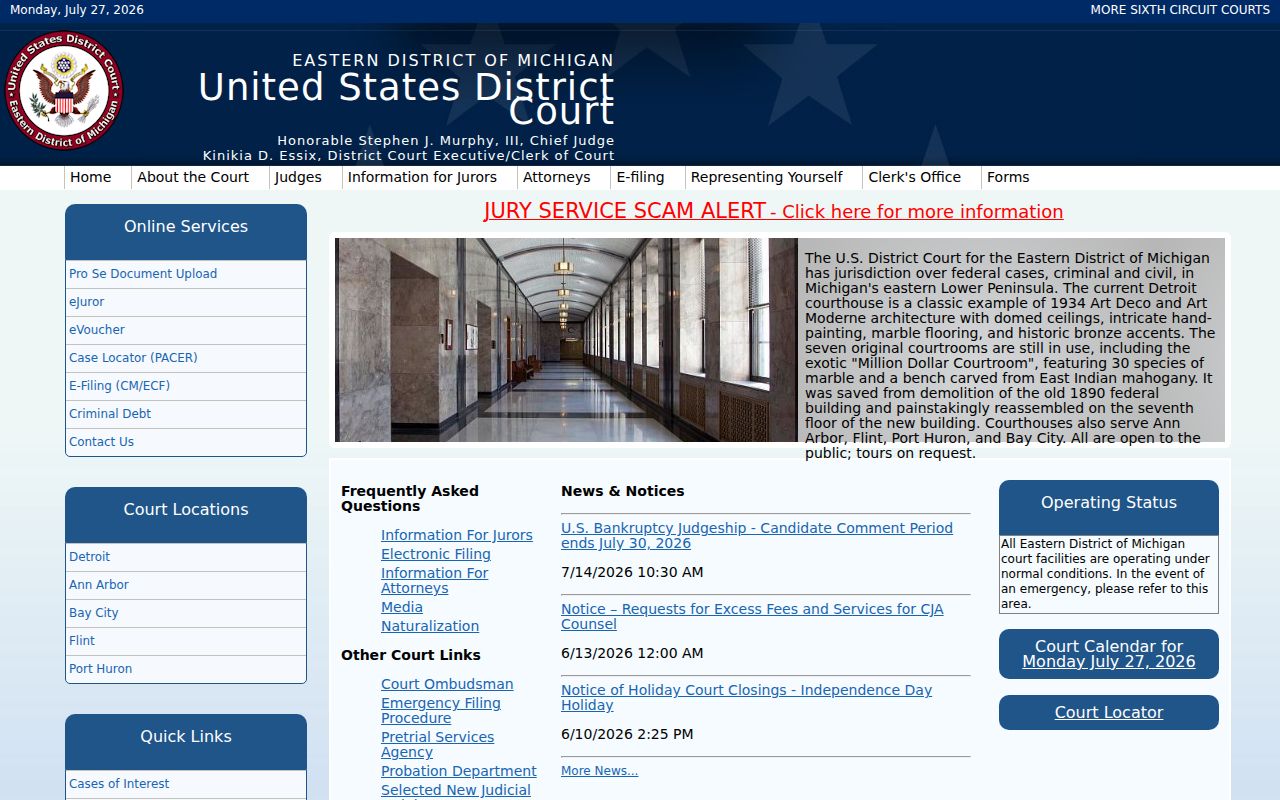
This federal docket is separate from Court Explorer, MiCOURT, ICHAT, and the Oakland County jail locator.
Federal prisoners are located through the Bureau of Prisons Inmate Locator.
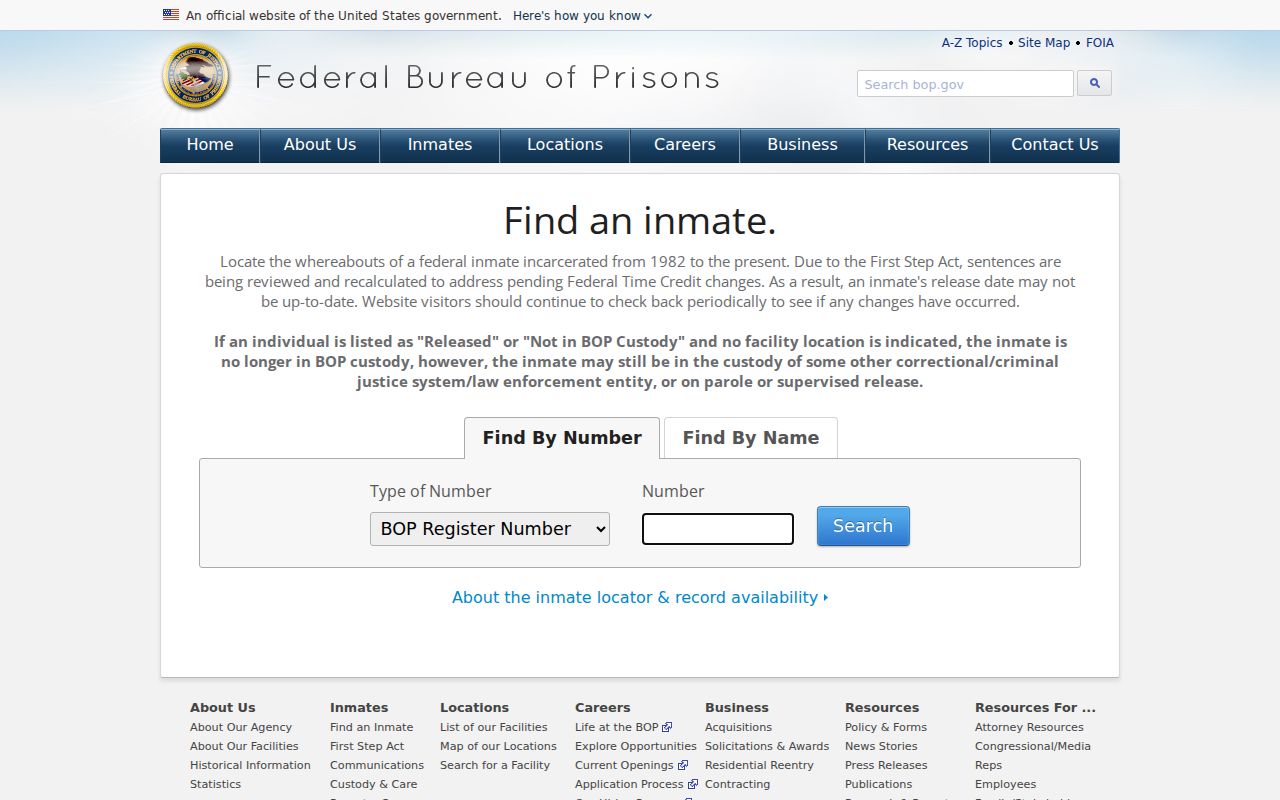
BOP results may show a register number, age, race, sex, release date, and location. A federal custody result does not replace the federal judgment or docket.
Oakland County Criminal Records by City
Oakland County has many police agencies and local district courts. The three largest incorporated cities in the project research are Troy, Farmington Hills, and Southfield. Their police departments keep their own incident reports, while current custody moves through the Oakland County jail and a bound-over felony continues in Sixth Circuit. Each city record page keeps that local chain distinct.
Troy Criminal Records
Troy Police reports and 52-4 District Court cases begin with city channels.
Farmington Hills Criminal Records
Police FOIA records and 47th District Court dockets use separate local routes.
Southfield Criminal Records
Southfield Police, 46th District search, and eligible online warrant review form the local path.
City population figures in the research were approximate routing aids because the dynamic Census table could change. No unverified number is published here.